DAY FIFTY-SIX: Why Direct Action?
TennCare Sit-in modeled on the success of the Civil Rights Movement.
(NASHVILLE, August 14, 2005) Many times people ask us why we use direct action? There are so many ways we have answered that. I thought this would be a great time to share with everyone why we believe direct action is necessary, and we feel this has never been expressed more perfectly then in Martin Luther King Jr.’s “Letter form a Birmingham Jail.” Following are some excerpts.
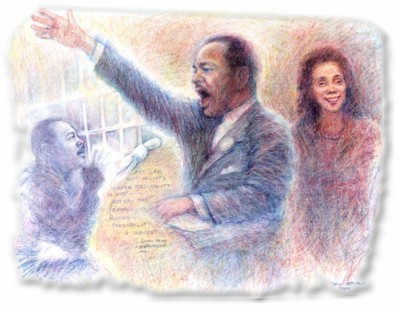
Dr. Martin Luther King and Coretta Scott King by Sher Stewart.
“Why direct action? Why sit-ins, marches, etc.? Isn’t negotiation a better path?” You are exactly right in your call for negotiation. Indeed, this is the purpose of direct action. Nonviolent direct action seeks to create such a crisis and establish such creative tension that a community that has constantly refused to negotiate is forced to confront the issue.
So the purpose of the direct action is to create a situation so crisis-packed that it will inevitably open the door to negotiation.
Actually, we who engage in nonviolent direct action are not the creators of tension. We merely bring to the surface the hidden tension that is already alive. We bring it out in the open where it can be seen and dealt with.
These are just a few lines out of a great letter that covers a wide range of reasons why direct action is a means to deal with society’s inequities. Inequities that lead to oppression of one group or another. We, people with disabilities, are one of those groups. That is why we use nonviolent direct action as a means to redress issues.
- Tennessee ADAPT
|