Gov. Bredesen created consent decree changes he is going to court to overturn.
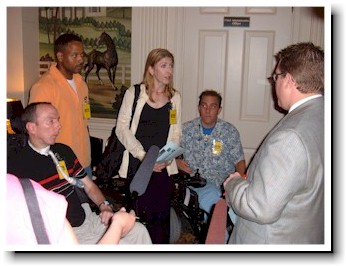 (NASHVILLE, July 6, 2005) Yesterday, people with HIV and AIDS joined the demonstration outside Tennessee Governor Phil Bredesen’s office. People infected with HIV or who have AIDS have much to fear if they are trapped in the governor’s massive healthcare cuts. (NASHVILLE, July 6, 2005) Yesterday, people with HIV and AIDS joined the demonstration outside Tennessee Governor Phil Bredesen’s office. People infected with HIV or who have AIDS have much to fear if they are trapped in the governor’s massive healthcare cuts.
"It's like a double whammy," said one of the HIV/AIDS patients losing prescription coverage. "You find a treatment that works, but many people will be worse off after stopping treatment than if they had never been on it."
TennCare spokeswoman Marilyn Elam said unlimited prescription benefits are a major reason for the program's increasing costs.
"If I get sick and put in the hospital,” said Tim Vance of Dowelltown, “then it's going to cost the state a lot more than my medicines."
Gov. Bredesen has blamed the need for enormous cuts in enrollment on consent decrees made rather than admit the state was involved in illegal activity. Testimony in the
Grier case however, shows that Gov. Bredesen directed all of the changes and approved the consent decrees.
Bredesen’s website states:
Following a full year of study, the Governor in 2004 proposed a comprehensive TennCare reform strategy designed to preserve full enrollment by placing reasonable limits on benefits. The plan won broad support from legislators, providers and enrollees, but public-interest lawyers thwarted it by refusing to lift legal roadblocks to reform.
[http://www.tennessee.gov/governor/Tenncare.do]
The governor praised the consent decrees at the time, but now Bredesen condemns the decrees and has gone back into court at the taxpayers expense to change the settlements. His own declaration that TennCare must undergo massive enrollment cuts appears to be because of his own negligence and mismanagement.
 "I think what this shows is that the governor has been distracting the public with talk of the consent decrees," said Michelle Johnson of the Tennessee Justice Center. "The problem for the taxpayers is that if we have the wrong diagnosis for the problem, we are going to get the wrong treatment." "I think what this shows is that the governor has been distracting the public with talk of the consent decrees," said Michelle Johnson of the Tennessee Justice Center. "The problem for the taxpayers is that if we have the wrong diagnosis for the problem, we are going to get the wrong treatment."
"There were always financial problems in the TennCare program,” said Manny Martins who oversaw the TennCare program last year for Bredesen, “but I did not relate them to the consent decree."
Today the Grier testimony has been made over changing the definition of what is "medically necessary." The governor is proposing to restrict the definition, which advocates for enrollees say will significantly lessen the effect of doctors' opinions on treatment. Dr. Stephen Cha said making the definition more restrictive would eliminate important and necessary care that doctors know to be effective but haven't been the subject of clinical trials.
"We're not talking about what's cost effective,” said Dr. Cha, a clinical scholar in the Department of General Internal Medicine at Yale University, “we're talking about what's less adequate.”
-Tim Wheat
|